How Companies Actually Make Money (Beyond the Obvious)
Valery Mays
September 25, 2026
At first glance, understanding how a company makes money seems simple. A restaurant sells food. A clothing company sells clothes. A hotel sells rooms. A software company sells software. Customers pay, the company collects the money, and whatever remains after expenses becomes profit.
But modern businesses are rarely that straightforward. The product you notice is not always the product generating the most profit. Some companies sell products cheaply to attract customers and make money somewhere else. Others give their main service away for free and charge a small percentage of users. Some barely profit from selling products at all and instead make money from advertising, financing, subscriptions, commissions, licensing, or services attached to those products.
Understanding a company therefore requires looking beyond what it sells and asking a more useful question: where does the money actually come from?
Revenue is not the same as profit
The first important distinction is between revenue and profit. Revenue is the money a company brings in from its business activities. Profit is what remains after relevant expenses are deducted.
Imagine a company sells $1 million worth of products during the year. That sounds impressive, but suppose manufacturing those products costs $500,000. Salaries cost another $250,000. Rent, advertising, shipping, software, insurance, taxes, and other expenses consume another $200,000.
The company generated $1 million in revenue but may have only $50,000 left after those costs.
This is why enormous sales do not automatically mean an enormously profitable business. How much a company keeps can matter just as much as how much it sells.
The simplest model is still selling something for more than it costs
Many businesses operate on the traditional model of buying or producing something and selling it at a higher price.
A furniture company purchases materials, pays workers to manufacture furniture, and sells the finished products. A retailer buys products wholesale and resells them at higher retail prices. A restaurant purchases ingredients and turns them into meals customers are willing to pay more for.
The difference between the selling price and the direct cost of providing the product contributes to the company’s gross profit.
But even this model becomes complicated quickly.
Companies need to consider rent, salaries, marketing, returns, damaged products, payment-processing fees, customer service, taxes, technology, and many other expenses.
A product can have a healthy markup and still belong to an unprofitable company.
Subscription businesses sell access instead of ownership
One of the most important modern business models is the subscription.
Instead of asking customers to make one large purchase, companies charge them repeatedly for continued access.
Streaming services use subscriptions. Software companies use them. Gyms, media publications, cloud-storage providers, meal services, and many other businesses do too.
The appeal is predictable recurring revenue.
If a company begins the month with one million subscribers paying $10 each, it has a clearer idea of its expected revenue than a company that must convince customers to make a completely new purchase every month.
The challenge is retention.
Subscription companies need customers to continue believing the service is worth paying for. Losing subscribers, commonly called churn, can become one of the most important measures of business health.
Freemium companies make money from the minority who pay
Many digital products offer surprisingly capable free versions.
That does not necessarily mean the company has no business model.
It may be using freemium.
Under this model, a large number of users receive basic functionality for free while a smaller percentage pay for premium features, additional storage, advanced capabilities, fewer limitations, or business functionality.
The free product serves several purposes.
It reduces the barrier to trying the service. It helps the product spread. It can create network effects when more users make the platform more useful.
The company does not necessarily need everyone to pay.
It needs enough paying customers to support the economics of the entire user base.
Advertising means your attention has value
Some of the world’s most widely used online services can be accessed without directly paying money.
Search engines, social networks, media platforms, and many mobile applications often make substantial revenue from advertising.
The company attracts an audience.
Advertisers pay for access to that audience.
The platform may allow advertisers to target groups based on factors such as location, interests, search behavior, demographics, or other signals, depending on the service and applicable privacy rules.
This changes how you should think about the product.
The user receives a service.
The advertiser provides much of the revenue.
The company’s economic challenge is therefore not simply attracting users. It needs to create enough useful engagement and advertising opportunities to turn that audience into revenue.
Marketplaces make money by standing between buyers and sellers
A marketplace does not necessarily need to own what it sells.
It can connect people who want something with people who provide it.
Travel-booking platforms connect travelers with accommodation providers. Food-delivery platforms connect customers, restaurants, and couriers. Online marketplaces connect shoppers with merchants. Freelance platforms connect companies with independent workers.
The marketplace can then take a commission or charge transaction fees.
Suppose a customer pays $100 for a service and the platform keeps $15.
The company’s revenue may be that $15 rather than the entire $100 transaction value.
This distinction becomes important when analyzing marketplace businesses because enormous amounts of money can move through a platform without all of it belonging to the company.
Payment companies can make tiny amounts millions of times
Some business models depend on extremely small fees repeated at enormous scale.
Payment processors are a good example.
Every time a customer makes a transaction, different companies involved in processing that payment may receive fees.
A tiny percentage of one coffee purchase is insignificant.
A tiny percentage across billions of dollars in transactions becomes a major business.
This model appears throughout the economy.
Companies can make money from transaction fees, booking fees, service charges, processing fees, withdrawal fees, foreign-exchange spreads, and many other small charges.
Individually, they look minor.
At scale, they can become the core business.
Some companies make more money after the original purchase
The first sale can simply create the relationship.
Consider a printer sold relatively cheaply while replacement ink remains expensive. A gaming console may lead to years of spending on games, subscriptions, accessories, and digital purchases. A coffee machine can create recurring demand for compatible capsules.
This is sometimes described as a razor-and-blades model.
The original product creates an installed customer base.
The recurring purchases generate much of the long-term economics.
This is why analyzing only the price of the initial product can give a misleading picture of the business.
The important number may be how much the average customer spends during the years after buying it.
Financing can be more profitable than the product itself
Some companies do not simply sell products.
They help customers finance them.
Automotive businesses are a useful example. The visible transaction involves selling a vehicle, but financing, leasing, insurance-related products, warranties, and other services can create additional revenue and profit.
Retailers can also benefit from credit programs, installment plans, or partnerships with financial providers.
This creates another layer to the business.
A company that appears to make money from physical products may partly operate like a financial-services company.
Understanding the real economics means examining every part of the customer relationship, not just what happens at the checkout counter.
Software can have unusually attractive economics
Software businesses can behave differently from physical-product companies because producing another copy of software can be relatively inexpensive.
Building the first version may require years of engineering work and significant investment.
But once the software exists, allowing another customer to access it may cost far less than manufacturing another physical product.
This can create high gross margins, particularly for successful software businesses operating at scale.
The company still has major expenses such as engineering, cloud infrastructure, sales, customer support, and marketing.
But the relationship between production and growth is different from a factory that needs additional raw materials for every additional product.
This is one reason scalable software businesses have attracted so much investment.
Licensing lets companies make money from intellectual property
A company does not always need to manufacture the final product containing its technology or brand.
It can license intellectual property to someone else.
That intellectual property might include software, patents, characters, music, designs, technology, formulas, trademarks, or brands.
The licensee pays for permission to use it under agreed conditions.
Entertainment companies can license characters for toys and clothing. Technology companies can license software. Sports organizations can license branding for merchandise.
Licensing can be attractive because the company can generate revenue from an asset without directly producing every product that uses it.
Services can make a product business more valuable
A company may appear to sell equipment while making significant money from services surrounding that equipment.
A manufacturer might sell machines and then charge for maintenance, spare parts, training, monitoring, software, or extended support.
The initial equipment sale establishes the relationship.
The services create recurring revenue over many years.
This is particularly common in business-to-business industries where customers depend on equipment remaining operational.
Once a company has installed a critical system inside a customer’s operation, the ongoing relationship can become more valuable than the original sale.
Data can create value without literally being sold
People often hear that technology companies “sell your data.”
Sometimes data can be shared or transferred under particular business arrangements, but the more common advertising model can be more nuanced.
A company may use information about users to improve targeting without directly handing advertisers a database containing everyone’s personal information.
The advertiser pays the platform to reach a particular type of audience.
The platform uses its information to decide who sees the advertisement.
Either way, data can have significant economic value because it improves personalization, recommendations, advertising, fraud detection, product development, and business decisions.
The important point is that information itself can become an asset even when customers never directly purchase it.
Loss leaders can attract customers who spend elsewhere
Sometimes companies intentionally sell certain products with extremely low margins or even at a loss.
Why would a business deliberately do that?
Because the product attracts customers.
A supermarket might offer a highly competitive price on something shoppers frequently compare, expecting them to buy other higher-margin items during the same visit.
A digital service might provide a generous free product because it introduces customers to a larger ecosystem.
The profitability of an individual product therefore cannot always be analyzed in isolation.
Its job may simply be to bring customers through the door.
Ecosystems can make customers increasingly valuable
Some companies build collections of products and services designed to work together.
A customer buys one device.
Then they purchase accessories.
They subscribe to cloud storage.
They buy applications.
They use the company’s payment service.
Eventually, switching to another provider becomes inconvenient because so many parts of their digital life are connected.
From the company’s perspective, the original product becomes an entry point into an ecosystem.
This is why businesses increasingly measure customer lifetime value rather than focusing only on the profit from one transaction.
A customer who generates $50 today may ultimately generate thousands over a decade.
The best businesses often combine several models
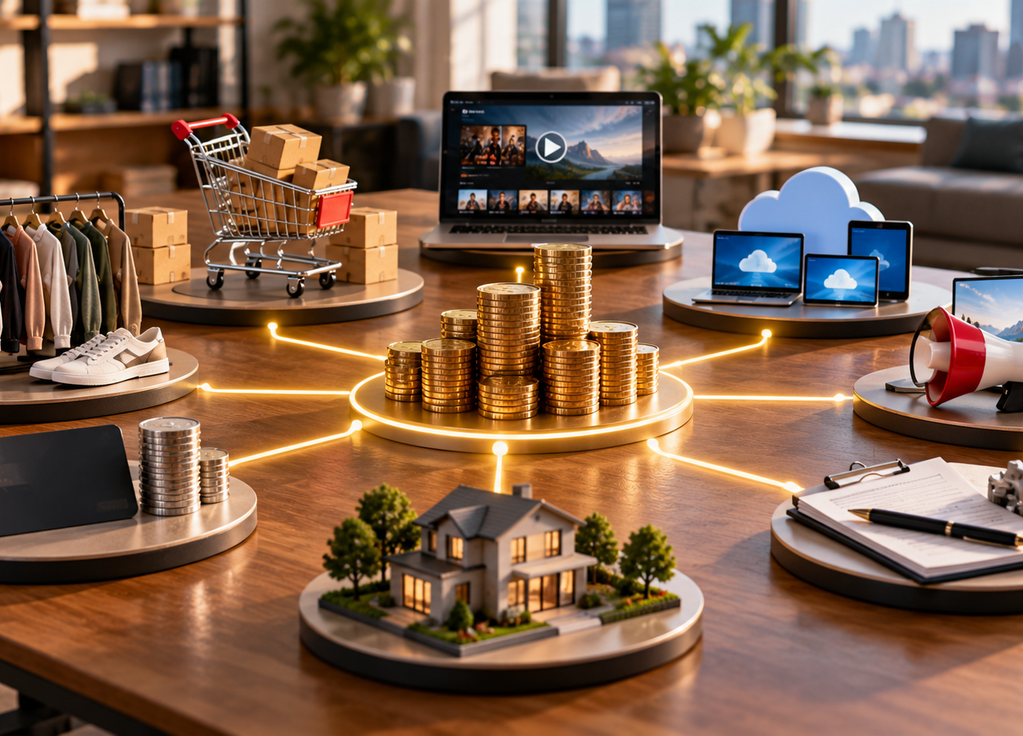
Large companies rarely depend on only one source of revenue.
A technology company might sell hardware, subscriptions, advertising, cloud services, applications, warranties, and financial services.
A media company might combine subscriptions, advertising, licensing, events, merchandise, and sponsorships.
A retailer might earn money from product sales, memberships, advertising, marketplace commissions, delivery services, and financial products.
Multiple revenue streams can make a company more resilient.
If one business slows down, another may continue growing.
It also means that understanding a company from the outside can be surprisingly difficult.
The most visible product is not necessarily the most important source of profit.
Follow the money, not just the product
When trying to understand any company, start with a few simple questions. Who actually pays the company? What exactly are they paying for? How often do they pay? How expensive is it for the company to provide that product or service? What happens after the first purchase? And which parts of the business generate the highest margins?
Those questions reveal much more than simply asking what the company sells.
A business is ultimately a system for creating value, capturing some portion of that value as revenue, and keeping enough after expenses to sustain itself.
Sometimes that system is obvious.
A customer buys a sandwich.
The restaurant makes money.
But sometimes the free app, discounted device, cheap subscription, or convenient marketplace you are using is only the front door.
The real business model is what happens after you walk through it.